How Do You Deploy Kubernetes in Production Safely?
A practical guide to deploying Kubernetes in production safely, covering cluster design, security, GitOps, observability, and day-2 operations.
Deploying Kubernetes in production is not just a question of getting workloads running. The real challenge is operating a cluster that can survive failures, enforce security boundaries, support repeatable releases, and remain understandable when something goes wrong.
Many teams can spin up a cluster quickly. Far fewer can answer the harder production questions: how will upgrades be handled, how are secrets protected, what happens during node failure, how do you roll back safely, and how do you keep configuration drift from creeping in over time?
This article breaks down the production Kubernetes problem, the standard approaches teams use, the tradeoffs involved, and a practical operating model for running Kubernetes and k3s safely in real environments.
The Problem: Production Kubernetes Fails in the Day-2 Details
The first cluster is usually easy. The second cluster exposes the real work.
Kubernetes in production has to handle several concerns at once:
- Reliable scheduling across nodes and availability zones
- Safe rollout and rollback behavior
- Secure access control and secret handling
- Persistent storage for stateful workloads
- Network policy and ingress management
- Monitoring, logging, and incident response
- Cluster upgrades and version skew
- Multi-team or multi-tenant isolation
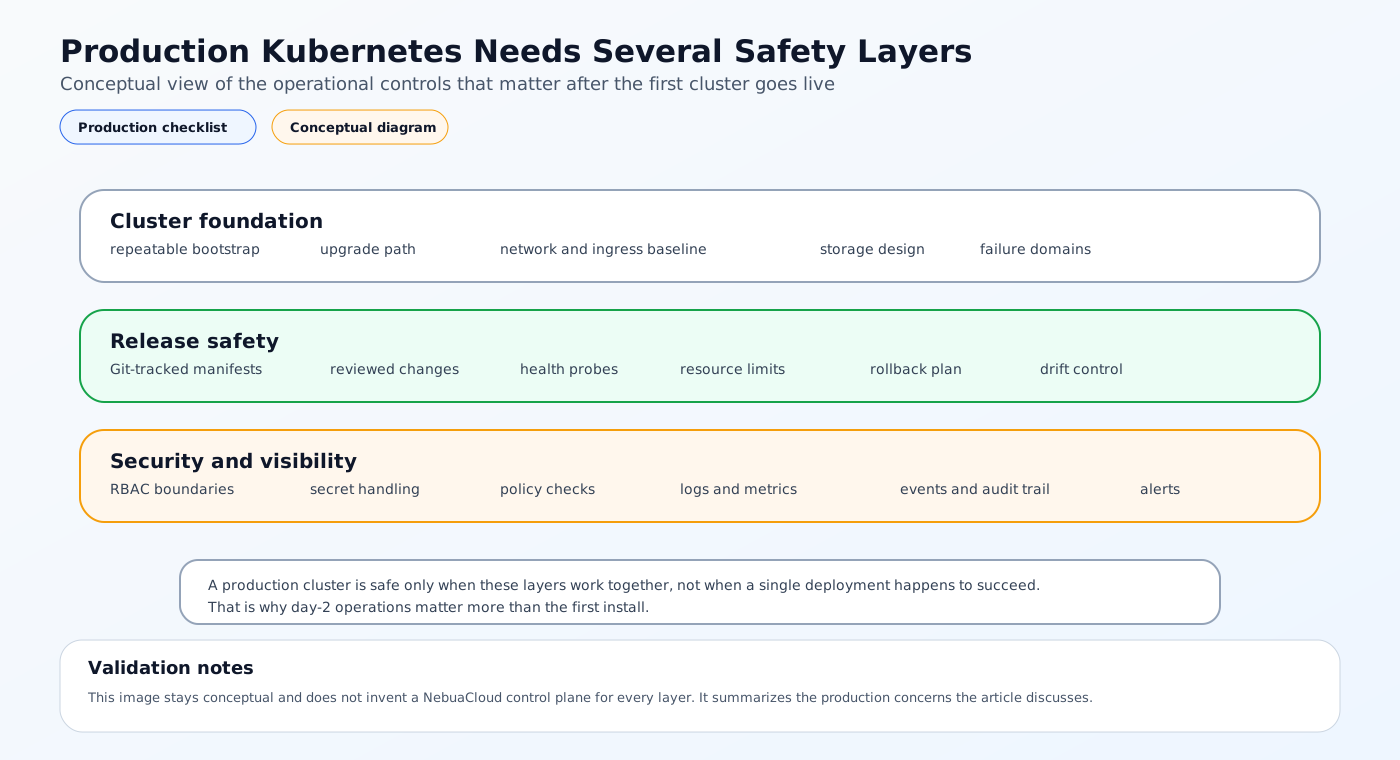
When these pieces are not designed together, the platform often looks healthy during deployment but becomes fragile in day-to-day operations.
Why this matters
Production systems rarely fail in a clean way. A node drains unexpectedly, a persistent volume stalls, a certificate expires, a rollout hangs, or a manual hotfix creates drift between Git and the live cluster.
If the platform does not have a clear operating model, each incident becomes an ad hoc investigation instead of a controlled recovery process.
What Safe Kubernetes Deployment Actually Means
“Safe” in production does not mean risk-free. It means the platform is designed so failures are contained, change is traceable, and recovery is predictable.
In practice, safe deployment usually includes:
- Declarative infrastructure and application manifests
- Repeatable cluster bootstrap and upgrade procedures
- Strong RBAC and secret management
- Health checks, resource limits, and rollout controls
- Observability that covers both cluster and application layers
- Backup and disaster recovery plans that are tested, not assumed
That is the difference between running Kubernetes as a lab cluster and running it as a production platform.
Current Approaches Used in Industry
Teams usually choose one of several common paths when deploying Kubernetes in production.
Managed Kubernetes
Cloud-managed services such as EKS, GKE, and AKS remove much of the control plane burden. This is attractive because it reduces the number of components the platform team must operate directly.
Managed services are often a good fit when the organization already runs heavily in a single cloud and wants strong integration with IAM, load balancers, and storage services.
Self-managed Kubernetes
Some teams prefer full control over the cluster stack using kubeadm or a custom bootstrap process. This can be useful in private data centers, hybrid environments, or regulated settings where the team needs full visibility into every component.
The cost is higher operational overhead. The team owns networking, upgrades, etcd strategy, observability, and recovery procedures.
Lightweight Kubernetes with k3s
k3s is often used for smaller production footprints, edge deployments, internal platforms, and distributed environments. It keeps the Kubernetes API while reducing overhead, which makes it practical when the goal is to run Kubernetes with less infrastructure weight.
k3s still needs the same production discipline as any other Kubernetes distribution. The smaller footprint does not remove the need for backups, security, policies, or observability.
The Main Risks in Production
Most production Kubernetes incidents trace back to one or more of these areas.
1. Weak cluster bootstrap and upgrade strategy
If cluster creation is manual, new environments tend to drift. If upgrades are improvised, version skew and component mismatch become likely.
Production needs a repeatable method for bootstrapping clusters, installing core add-ons, and moving through supported versions.
2. Incomplete security boundaries
Namespaces are useful, but they are not a complete security model on their own. A production cluster needs:
- RBAC that matches team responsibilities
- Service account scoping
- NetworkPolicy where supported
- Admission policies for baseline controls
- Secret storage that is not plain text in Git
3. Missing resource controls
Without requests, limits, quotas, and scheduling controls, one workload can consume resources that another workload needs.
This is especially important in multi-tenant environments where several teams or applications share the same infrastructure.
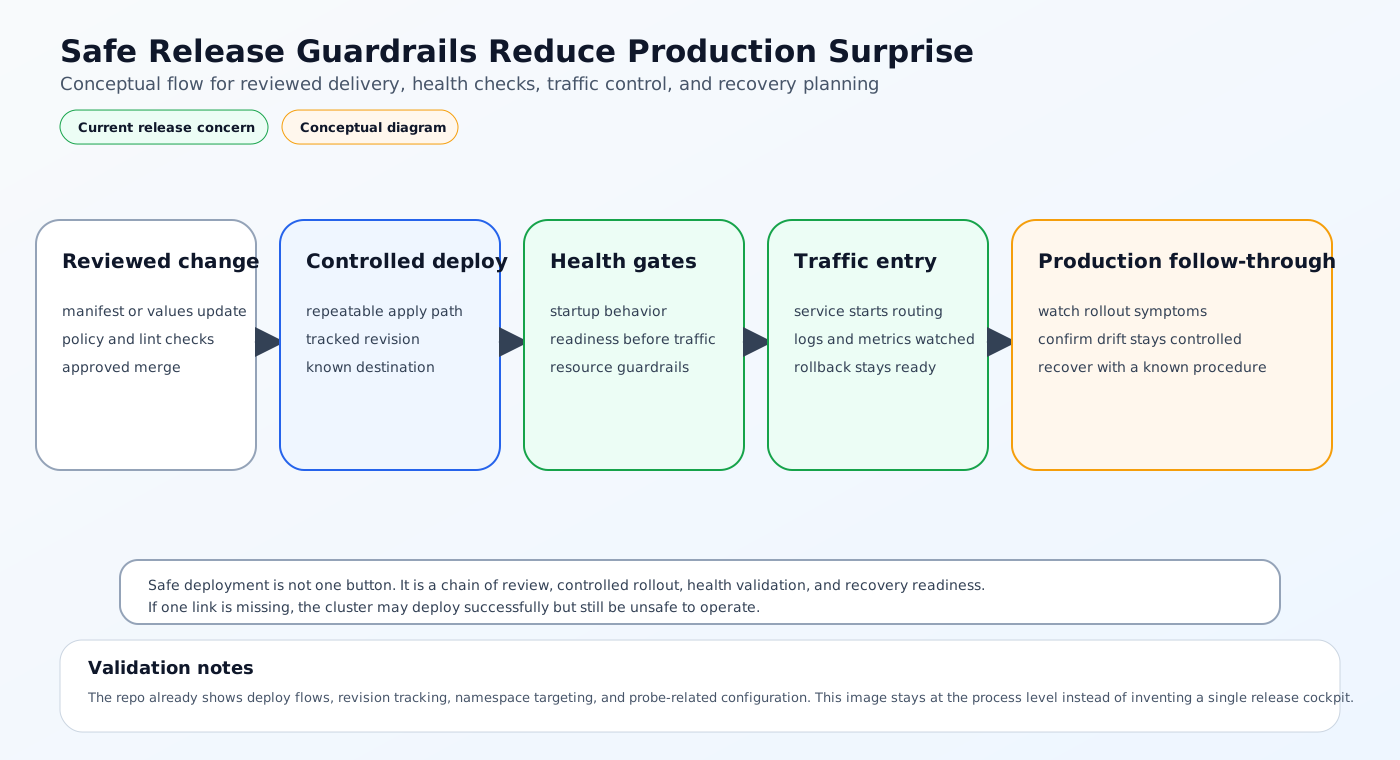
4. Poor release safety
Deployments that lack health checks, progressive delivery, or rollback plans create avoidable incidents.
A production workload should fail closed and recover in a predictable way, not rely on manual intervention as the normal path.
5. Weak visibility
If the platform team cannot quickly answer whether the issue is in the node, control plane, network, storage, or workload layer, incident response slows down.
Observability needs to include cluster metrics, application metrics, logs, and event streams.
A Practical Production Model
A safe Kubernetes deployment model usually combines infrastructure discipline with application delivery discipline.
1. Treat cluster infrastructure as code
Provision clusters, networking, and supporting services through declarative tooling such as Terraform, Helm, or GitOps-managed manifests.
This makes cluster state reproducible and reviewable.
2. Use GitOps for workload delivery
GitOps works well in production because it gives teams a clear source of truth for what should be running.
A typical flow looks like this:
- A developer opens a pull request with a manifest or Helm values change.
- CI runs linting, policy checks, and build validation.
- The change is merged into Git after review.
- A GitOps controller reconciles the target Kubernetes cluster.
- Monitoring verifies the deployment and surfaces anomalies.
This pattern reduces manual cluster access and creates a reliable audit trail.
3. Separate platform services from business workloads
Core services such as ingress, DNS, certificate management, storage, logging, and monitoring should be standardized first.
Application teams should deploy on top of that platform instead of re-implementing those components independently.
4. Design for failure domains
Production Kubernetes should account for:
- Node failure
- Zone failure
- Storage failure
- Image pull failure
- Dependency timeout
- Bad rollout
If the cluster cannot tolerate these conditions in a controlled way, it is not production ready.
5. Build security into the pipeline
Security should not be an afterthought. Validate manifests before they reach the cluster and enforce guardrails in-cluster.
Common controls include:
- Image scanning
- Policy enforcement with Kyverno or OPA/Gatekeeper
- Secret encryption with SOPS or external secret stores
- RBAC reviews for service accounts and operators
How NebuaCloud Fits Into This Model
Once the production model is clear, the next problem is operating it consistently across clusters and teams. That is where NebuaCloud fits naturally.
NebuaCloud is focused on Kubernetes management, GitOps workflows, multi-tenant infrastructure, and simplified deployment of production workloads. For teams that need repeatable production Kubernetes, that combination helps reduce the operational friction around cluster management and workload delivery.
What this means for production teams
NebuaCloud can help teams:
- Manage Kubernetes and k3s clusters through a consistent operating layer
- Apply GitOps workflows to production workloads
- Isolate teams or tenants with stronger boundaries than namespaces alone
- Reduce the effort required to standardize deployments across environments
- Use observability signals to detect drift, rollout issues, or abnormal behavior faster
In practice, this is useful when the problem is not “how do we create a cluster?” but “how do we run several clusters safely and consistently over time?”
Practical Example: Safely Deploying a Stateful App
Consider a PostgreSQL-backed application that must run in production with low downtime.
Safe deployment workflow
- Provision the cluster using declarative infrastructure.
- Install core services such as ingress, certificate management, storage, and monitoring.
- Store the application manifests in Git.
- Use GitOps to deploy the stateless API layer first.
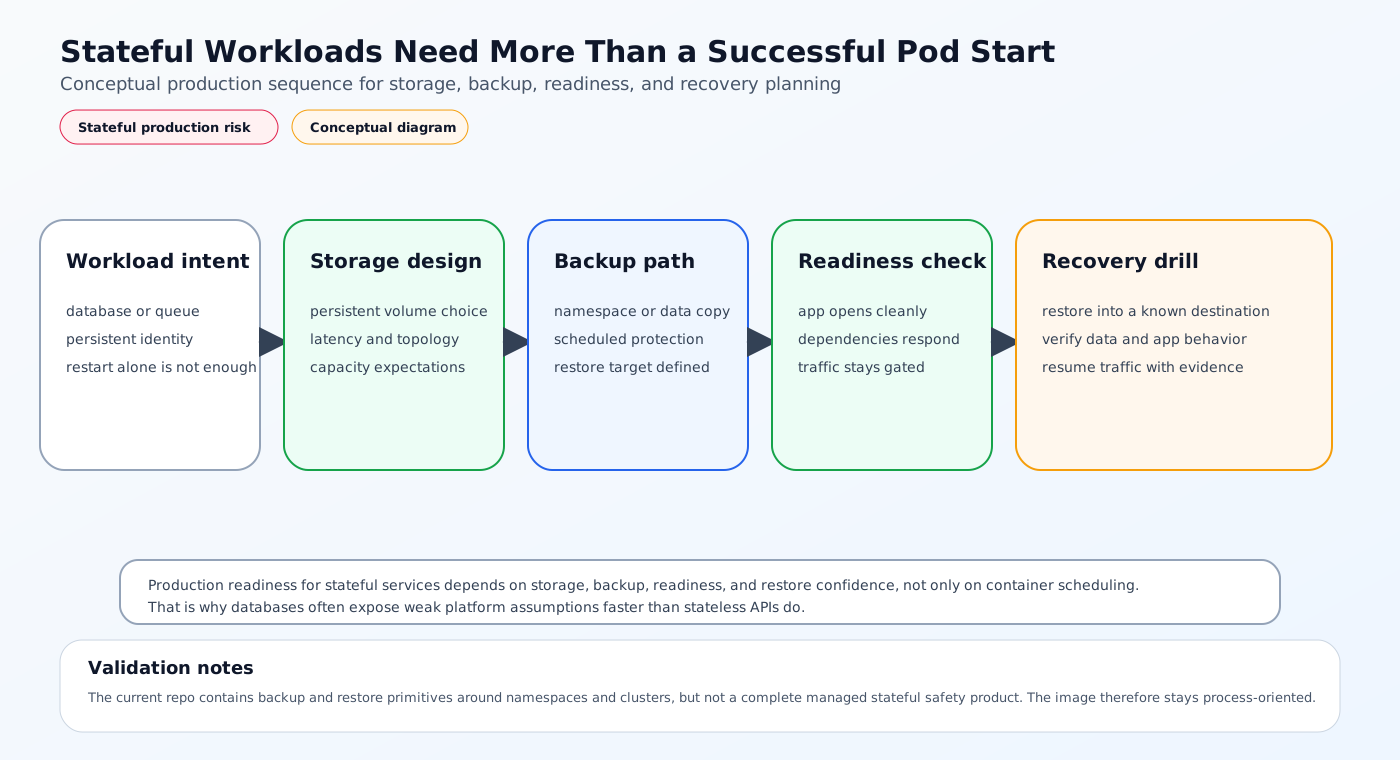
- Deploy PostgreSQL with persistent storage, resource requests, and a tested backup plan.
- Validate readiness and liveness probes before allowing traffic.
- Use staged rollout or maintenance windows for schema changes.
- Monitor saturation, latency, and error rates after each change.
Why this matters
Stateful workloads are where many Kubernetes production setups become fragile. If storage, backup, and recovery are not explicit, the cluster may be able to deploy the workload but not support it safely.
The same principle applies to internal services, queues, caches, and background workers. Production readiness is about operational behavior, not just whether a pod starts.
Production Checklist
Before calling a Kubernetes environment production ready, confirm the following:
- Cluster creation is repeatable
- Upgrades have a documented path
- RBAC is least privilege by default
- Secrets are encrypted or externally managed
- Resource requests and limits are defined
- Health probes are in place
- Logging and metrics are centralized
- Alerts cover cluster and workload failures
- Backups are tested
- Rollbacks are part of the release process
If even one of these is missing, the platform may work, but it is not yet operating with production discipline.
Conclusion
Deploying Kubernetes in production safely is mostly about reducing uncertainty. That means standardizing cluster creation, using GitOps for change control, enforcing security and resource boundaries, and building observability and recovery into the platform from the beginning.
Managed Kubernetes, self-managed clusters, and k3s can all work in production. The right choice depends on operational maturity, infrastructure constraints, and the level of control the team needs. What matters most is the operating model around the cluster, not just the cluster itself.
For teams that want a cleaner way to manage Kubernetes, GitOps, multi-tenant isolation, and production workload deployment in one place, NebuaCloud provides a practical path to do that without forcing a different delivery model.
Try it with NebuaCloud -> deploy in minutes
Current Availability
NebuaCloud already shows important parts of this production model in the current codebase. The platform has cluster and namespace operations, Git-linked deployment paths, revision visibility, probe-related deployment parameters in service flows, logs and monitoring surfaces, and cluster-level backup and restore primitives.
At the same time, the full end-to-end "safe production deployment" model from this article is not yet exposed as one complete guided product workflow inside NebuaCloud. Some pieces are available today, while the broader safety model described here still represents the direction of the platform and should be treated as something that will be expanded in future releases.